
Preventative maintenance

Reduce unplanned production downtime as well as lost productivity and revenue with timely maintenance. 
hero-svg-source
icon-arrow

Reduce loss of revenue

Enable condition-based maintenance for improved Overall Equipment Effectiveness.

icon-arrow

Minimise downtime

Reduce number of unexpected breakdowns and emergency maintenance requests. 

icon-arrow

Lengthen asset lifespan

Equipment in good condition last longer.

Preventive maintenance with AI

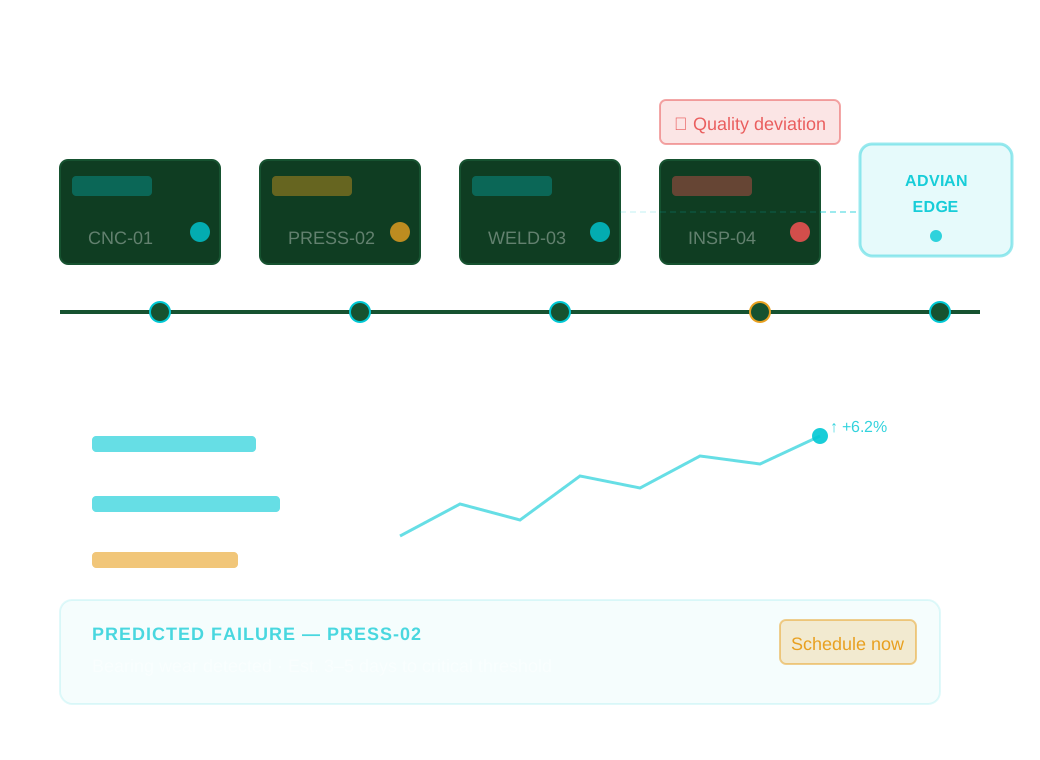
Effective predictive maintenance requires extensive utilisation of data. Data from production machines and IoT sensors enable AI-based predictive analytics to understand when individual machines or components are about to fail. By adding MES data, both actual and planned, to the analytics, the most optimal maintenance windows can also be found.
 
Predictions and suggested maintenance plans help manufacturers to move to condition-based maintenance. Now, equipment is fixed or replaced with minimal loss of productivity and revenue.


  • Capture the reality with the most suitable sensors

  • Get real-time insights from rich sensor data

  • Control processes or give user feedback to enable end-to-end optimisation

From calendar-based maintenance
to condition-based

Case Study

How we reduced Valtra's warranty costs with machine learning

Why Edge AI?

Our Smart Factory solutions are based on a combination of edge computing and artificial intelligence. Going under the term Edge AI, the technology opens completely new possibilities to manufacturers.

What is Edge computing?

Edge computing can make existing manufacturing processes more intelligent and autonomous. By moving computing closer to the edge of the network, for instance, to the production equipment, these automated manufacturing systems are now not only able to act by themselves without human intervention, but also to react and make decisions based on changes in circumstances.

What can AI do?

Artificial intelligence, especially machine learning, not only enables the software at the edges to detect patterns in the data it receives, but also to learn about correlations between data patterns and desired outcomes. When we let a computer analyse data and draw conclusions, we can give it positive or negative feedback so that over time the software will more often draw the desired conclusions.

Tell us about your quality assurance challenge.

Together we’ll identify the real improvement potential and whether it makes sense to invest. No sales pitch,  an honest assessment.


Asiantuntijat valkoisella taustalla 600 x 800 (1)

Petri Nikkola
Senior Sales Executive, Manufacturing
petri.nikkola@advian.fi

Book a discussion with our experts



Contact us